
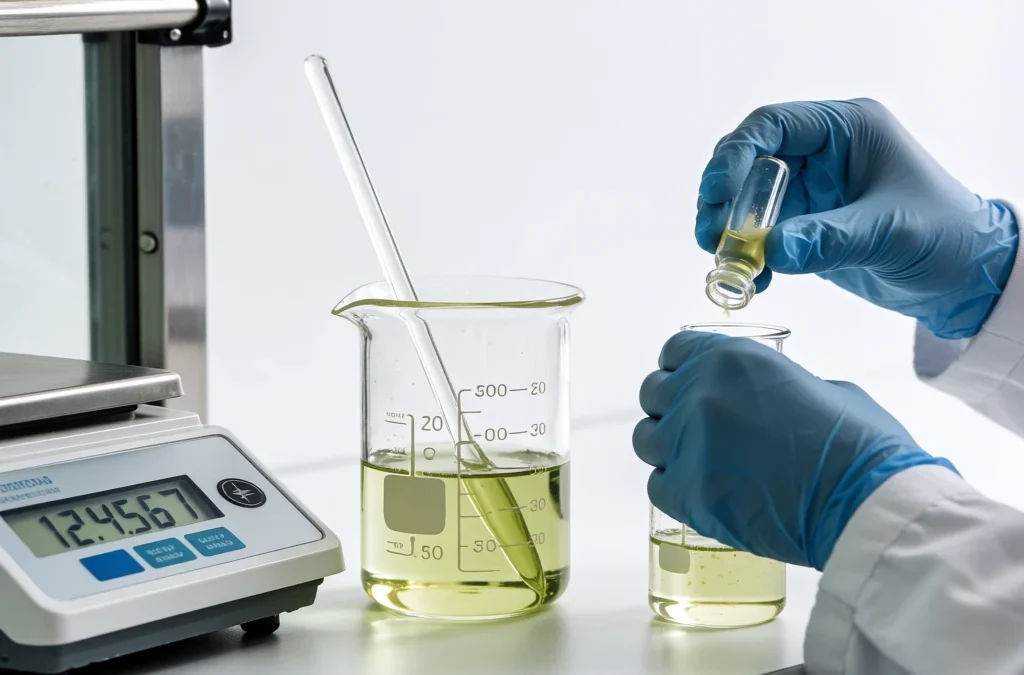
Every high-performance perovskite device is born twice: once in a beaker, and once in a furnace. The second birth is visible, dramatic, and endlessly photographed under the microscope. The first is invisible, silent, and almost entirely responsible for whether the final crystal behaves like a champion or a failure. Before a single grain of cesium lead iodide ever assembles into an ordered lattice, a crowded chemical negotiation is already underway in solution, and its outcome is written into the device long before annealing begins.
This pre-crystallization stage is where lead halide species collide with organic and inorganic cations, where solvents coordinate and release, and where intermediate complexes decide the size, uniformity, and defect density of everything that follows. Researchers chasing near-unity photoluminescence yields and brighter infrared light-emitting diodes have learned that polishing the furnace recipe cannot rescue a precursor solution that was chemically compromised from the start. The chemistry of the ink, not the drama of the oven, sets the ceiling on performance.
Understanding this hidden stage transforms how we think about materials fabrication. It reframes perovskite synthesis from a cooking exercise into a coordination chemistry problem, where ligand exchange, solvation shells, and colloidal assembly govern reproducibility across batches and laboratories. The analysis below unpacks the solution-phase intermediates, quantifies their influence with worked calculations, and connects precursor design directly to LED efficiency and manufacturing reliability.
On This Page
- The Invisible Chemistry That Precedes Every Perovskite Crystal
- Solution-Phase Intermediates and Their Chemical Identity
- Connecting Precursor Chemistry to Photoluminescence Yield
- Infrared LEDs and the Reproducibility Dividend
- Worked Calculations: From Equilibrium to Device Metrics
- Practical Protocols for Controlling Pre-Crystallization Chemistry
- The Strategic Lesson: Chemistry Before Crystallization Decides Everything
The Invisible Chemistry That Precedes Every Perovskite Crystal
Perovskite formation is routinely described as a simple sequence: dissolve precursors, spin-coat the film, anneal, and collect the reward. That narrative omits the decisive chapter. In the precursor ink, metal halide salts do not wait passively for evaporation; they oligomerize, coordinate with solvent molecules, and form colloidal clusters whose structure propagates into the final solid.
The solvent is never a neutral bystander. Dimethylformamide and dimethyl sulfoxide compete for coordination sites on lead centers, and the ratio of these interactions determines whether the ink remains a homogeneous molecular solution or collapses into premature aggregates. Controlling this balance is the first act of device engineering, long before any thin film touches a substrate.
From Dissolved Ions to Colloidal Intermediates
In a typical precursor, lead iodide dissolves through coordination with polar aprotic solvents, producing solvated ##[text{PbI}_2(text{S})_n]## species where ##[text{S}]## represents a solvent molecule. These solvated units are not static; they exchange ligands on timescales of picoseconds and assemble into larger iodoplumbate frameworks as concentration rises. The distribution of these frameworks is the true starting condition of crystallization.
When an organic cation such as methylammonium or formamidinium is introduced, it does not simply float among the lead species. It participates in acid-base chemistry with the solvent and with iodide, shifting the equilibrium between free ions and coordinated complexes. This shift changes the supersaturation profile, and supersaturation governs nucleation density, which in turn governs grain size and film morphology.
Colloidal intermediates add another layer. Iodoplumbate clusters can aggregate into nanoscale colloids stabilized by solvent and cation shells, and the size distribution of these colloids seeds the crystallization process. A narrow distribution yields uniform nucleation; a broad one produces mixed grain sizes, pinholes, and trap states that quietly degrade photoluminescence.
Why Supersaturation Governs the Final Lattice
Classical nucleation theory frames the barrier to crystal formation through the free-energy cost of creating a new interface. The critical radius and nucleation rate depend exponentially on supersaturation, so small changes in solution chemistry produce outsized changes in the number of nuclei formed per unit volume. This exponential sensitivity explains why precursor chemistry dominates reproducibility.
Here ##[J]## is the nucleation rate, ##[gamma]## the interfacial energy, ##[V_m]## the molar volume, and ##[S]## the supersaturation ratio. Because ##[ln S]## sits squared in the denominator of the exponent, a modest increase in supersaturation can raise nucleation rates by orders of magnitude, flooding the film with small grains before the desired growth regime is reached.
Precursor chemistry controls ##[S]## directly by determining how much material remains dissolved versus sequestered in intermediates. A well-designed ink holds lead species in stable coordination until solvent removal drives a controlled supersaturation ramp, producing fewer nuclei and larger, more perfect crystals with fewer non-radiative recombination centers.
We Also Published
Solution-Phase Intermediates and Their Chemical Identity
The intermediates that matter most are not exotic curiosities but well-characterized coordination compounds. Lead iodide in polar aprotic solvents forms a spectrum of iodoplumbate anions, from simple ##[text{PbI}_3^-]## units to extended chains and sheets, each with distinct optical and thermodynamic signatures. Their relative abundance is the fingerprint of a healthy or compromised ink.
Spectroscopic probes reveal these populations directly. Ultraviolet-visible absorption shows characteristic bands for different iodoplumbate species, while nuclear magnetic resonance tracks cation-solvent interactions. When these signatures drift between batches, device performance drifts with them, often before any obvious visual change in the ink.
Iodoplumbate Frameworks and Colloidal Assembly
As concentration increases, iodoplumbate units condense into larger frameworks through shared iodide bridges. These frameworks can remain dissolved or precipitate as colloidal particles depending on the solvent's coordinating strength and the presence of stabilizing cations. The boundary between dissolved and colloidal states is where reproducibility is won or lost.
Colloidal particles in the ink act as pre-formed nuclei. If they are too numerous, the film crystallizes into a mosaic of small grains with abundant grain boundaries. If they are too few, nucleation becomes sporadic and films develop uneven coverage. The ideal ink maintains a controlled, narrow colloid population that releases material gradually during drying.
Additives and antisolvents are the practical levers for this control. Antisolvent dripping induces rapid supersaturation, but its effectiveness depends entirely on the intermediate distribution present at the moment of dripping. An ink with well-defined intermediates responds predictably; a poorly characterized ink responds chaotically, producing the batch-to-batch variability that plagues scale-up.
Quantifying Intermediate Populations
Consider a simplified equilibrium between free solvated lead and a dimeric intermediate. The association constant ##[K_a]## determines how much material resides in each state at a given total concentration, and this partitioning directly sets the effective supersaturation available for nucleation during drying.
If the total lead concentration is ##[C_0]## and the fraction in dimer form is ##[f]##, mass balance gives ##[C_0 = [text{PbI}_2(text{S})_2] + 2[text{Pb}_2text{I}_4(text{S})_2]##. Solving this quadratic relationship for a chosen ##[K_a]## reveals how sensitive the dimer fraction is to small concentration changes, explaining why dilution and concentration steps must be tightly controlled.
For a representative case with ##[K_a = 50 text{M}^{-1}]## and ##[C_0 = 0.8 text{M}]##, the monomer concentration solves to approximately ##[0.13 text{M}]##, leaving roughly 84 percent of lead in dimeric or higher-order form. That dominance means the ink's behavior is governed by oligomer chemistry, not by simple dissolved ions, and any model ignoring intermediates will mispredict nucleation.
Connecting Precursor Chemistry to Photoluminescence Yield
Photoluminescence quantum yield is the most sensitive report card a perovskite film can offer. It counts the fraction of excited carriers that recombine radiatively rather than surrendering energy to defects, and defects are overwhelmingly born during crystallization. Near-unity yields therefore certify that the pre-crystallization chemistry delivered an exceptionally clean lattice.
The link is quantitative. Non-radiative recombination rates scale with trap density, and trap density scales with the density of imperfect grain boundaries and uncoordinated surface sites. Precursor chemistry that produces fewer nuclei and slower, more ordered growth reduces both, pushing quantum yield toward its radiative limit.
Radiative and Non-Radiative Recombination Pathways
The internal quantum yield follows a simple competition between radiative and non-radiative rates. When trap-mediated recombination dominates, yield collapses even if the material's intrinsic radiative efficiency is excellent, which is precisely what happens in films crystallized from poorly controlled inks.
Suppose a high-quality film achieves ##[k_r = 2.0 times 10^7 text{s}^{-1}]## and ##[k_{nr} = 2.2 times 10^5 text{s}^{-1}]##, yielding a photoluminescence quantum yield of about 98.9 percent. A film from a degraded precursor might show ##[k_{nr} = 4.0 times 10^7 text{s}^{-1}]##, dropping the yield below 34 percent despite identical composition on paper.
This calculation exposes the stakes. The two films differ only in solution history, yet one glows brilliantly and the other barely emits. Device engineers who treat precursor preparation as a formality are effectively gambling with a factor-of-three loss in radiative efficiency before fabrication even begins.
From Quantum Yield to Device Efficiency
In an LED, the external quantum efficiency multiplies internal quantum yield by outcoupling and charge balance factors. A precursor-driven collapse in photoluminescence therefore propagates directly into dimmer devices, and no amount of clever device architecture fully compensates for a defective emissive layer.
Near-unity photoluminescence yields reported for optimized precursor routes translate into infrared LEDs with external efficiencies approaching practical ceilings. The improvement is not incremental polish; it reflects the elimination of a whole class of defects that originate in the beaker rather than the device stack.
- 01
- 02
- 03
- 04
Infrared LEDs and the Reproducibility Dividend
Infrared emitters for sensing, communication, and night-vision applications demand high radiance and stable output, and perovskite LEDs have emerged as credible contenders. Their efficiency ceiling is set by the emissive layer's defect landscape, which traces directly back to precursor chemistry. Cleaner inks mean brighter, more durable devices.
Reproducibility is the quieter prize. Laboratories that characterize their precursor intermediates routinely report tighter performance distributions across batches, because they catch chemical drift before it becomes device failure. This discipline separates research curiosities from manufacturable technologies.
Designing Inks for Consistent Device Output
Robust precursor design begins with solvent selection and strict water and oxygen exclusion. Coordinating solvent ratios are fixed by design rather than by habit, and cation stoichiometry is verified analytically. These controls stabilize the intermediate population and make the crystallization pathway predictable rather than accidental.
Process analytics close the loop. Inline spectroscopy can monitor iodoplumbate signatures in real time, flagging inks that have drifted before coating begins. Combined with standardized aging studies, such monitoring converts precursor chemistry from tacit craft knowledge into an engineering specification suitable for production lines.
Scaling From Beaker to Manufacturing Line
Scale-up magnifies every chemical inhomogeneity. Mixing times lengthen, local concentration gradients sharpen, and temperature excursions alter equilibrium positions. An ink that performs flawlessly in a milliliter vial can fail in a liter reactor unless intermediate chemistry is explicitly controlled at the larger scale.
Continuous-flow synthesis offers one answer, providing rapid, uniform mixing and tight thermal control that keep intermediate distributions stable. Whether through flow reactors or rigorously validated batch protocols, the principle is identical: the chemistry before crystallization must be specified, measured, and defended.
Worked Calculations: From Equilibrium to Device Metrics
Abstract chemistry becomes persuasive when numbers attach to it. The following worked problems translate intermediate equilibria, nucleation kinetics, and recombination statistics into concrete figures, demonstrating how solution-phase decisions propagate into measurable device outcomes. Each calculation uses representative values drawn from typical perovskite systems.
These exercises are not academic decoration. They model the reasoning a process chemist performs when diagnosing a failed batch or designing a new ink, and they show precisely where small chemical errors amplify into large performance losses.
Equilibrium and Nucleation Problems
Problem 1: Dimer Fraction in a Precursor Ink
Given ##[K_a = 50 text{M}^{-1}]## and total lead concentration ##[C_0 = 0.8 text{M}]##, find the fraction of lead in dimeric form. Let ##[x]## be monomer concentration; then ##[C_0 = x + 2K_a x^2]##. Solving ##[100x^2 + x - 0.8 = 0]## gives ##[x approx 0.0847 text{M}]##, so the dimer fraction is approximately 79 percent.
Problem 2: Supersaturation Ratio
If solubility at the drying front is ##[C_s = 0.05 text{M}]## and local concentration reaches ##[C = 0.60 text{M}]##, the supersaturation ratio is ##[S = C/C_s = 12]##. The logarithm ##[ln 12 approx 2.48]## enters the nucleation exponent squared, amplifying its influence dramatically.
Problem 3: Nucleation Rate Ratio
Compare nucleation rates at ##[S = 12]## and ##[S = 6]##, holding other terms constant. The exponent scales as ##[1/(ln S)^2]##, so the ratio of exponents is ##[(2.48/1.79)^2 approx 1.92]##, meaning the higher supersaturation raises the rate by roughly ##[e^{1.92} approx 6.8]## times.
Problem 4: Critical Radius Estimate
Using ##[r^* = 2gamma V_m/(k_B T ln S)]## with ##[gamma = 0.05 text{J/m}^2]##, ##[V_m = 6.2 times 10^{-5} text{m}^3/text{mol}]##, and ##[ln S = 2.48]## at 300 K, the critical radius evaluates to approximately ##[1.6 text{nm}]##, a plausible nucleus size for perovskite systems.
Recombination and Device Problems
Problem 5: Photoluminescence Quantum Yield
With ##[k_r = 2.0 times 10^7 text{s}^{-1}]## and ##[k_{nr} = 2.2 times 10^5 text{s}^{-1}]##, the yield is ##[2.0 times 10^7/(2.0 times 10^7 + 2.2 times 10^5) approx 0.989]##, or 98.9 percent, consistent with near-unity reports for optimized films.
Problem 6: Yield After Precursor Degradation
If degradation raises the non-radiative rate to ##[4.0 times 10^7 text{s}^{-1}]##, the yield becomes ##[2.0 times 10^7/(4.2 times 10^7) approx 0.476]##, a fall to 47.6 percent that illustrates how a single chemical variable can halve radiative output.
Problem 7: Trap Density From Lifetime
A measured lifetime of ##[tau = 45 text{ns}]## with ##[k_r = 2.0 times 10^7 text{s}^{-1}]## implies ##[k_{nr} = 1/tau - k_r approx 2.2 times 10^7 - 2.0 times 10^7 = 2.2 times 10^6 text{s}^{-1}]##, indicating substantial trap-mediated recombination relative to the optimized case.
Problem 8: External Quantum Efficiency
With internal yield 0.99, outcoupling factor 0.2, and charge balance 0.85, the external quantum efficiency is ##[0.99 times 0.2 times 0.85 approx 0.168]##, or 16.8 percent, a realistic figure for high-performance infrared perovskite LEDs.
Problem 9: Grain Boundary Density
For a 400 nm film with average grain size 200 nm, the boundary density scales as ##[1/d]##, giving roughly ##[5 times 10^6 text{m}^{-1}]## per unit length. Halving grain size doubles boundary density and, with it, the trap population available for non-radiative loss.
Problem 10: Batch Yield Statistics
If device efficiency follows a normal distribution with mean 15 percent and standard deviation 3 percent, the fraction exceeding 18 percent is ##[1 - Phi(1) approx 0.159]##, about 16 percent. Tightening precursor control to reduce ##[sigma]## to 1.5 percent raises that fraction to roughly 2.3 percent, a decisive manufacturing advantage.
Practical Protocols for Controlling Pre-Crystallization Chemistry
Translating insight into practice requires protocols that treat the precursor as a chemical system under active management. Solvents are dried and stored under inert atmosphere, salts are weighed with analytical precision, and dissolution is performed at controlled temperature with defined stirring times. These steps are unglamorous but decisive.
Characterization should precede fabrication. Absorption spectra, dynamic light scattering, and where available nuclear magnetic resonance provide rapid readouts of intermediate populations. An ink that fails these checks is discarded before it consumes expensive substrates and hours of annealing time.
Laboratory Checklist for Reliable Inks
A disciplined workflow begins with documented solvent purity and water content below strict thresholds. Cation ratios are verified by stoichiometric calculation and, ideally, by elemental analysis. Dissolution temperature and time are recorded, because both shift the equilibrium distribution of iodoplumbate species.
Antisolvent timing and volume are standardized against the measured intermediate profile rather than fixed by tradition. Aging studies establish a shelf life, and inks beyond that window are retired. Each of these controls removes a degree of freedom that would otherwise introduce batch-to-batch variability.
Reference Protocol Skeleton
# Simplified precursor quality-control workflow
def check_precursor(absorbance_peak, water_ppm, cation_ratio):
    if water_ppm > 50:
        return "REJECT: moisture exceeds threshold"
    if not (0.95 <= cation_ratio <= 1.05):
        return "REJECT: cation stoichiometry off-target"
    if absorbance_peak < 0.8:
        return "FLAG: intermediate profile shifted"
    return "ACCEPT: proceed to coating"

print(check_precursor(absorbance_peak=0.92, water_ppm=18, cation_ratio=1.01))
Such scripts are deliberately simple, but they encode the essential logic: reject early, reject cheaply, and never let a questionable ink reach the spin coater. Combined with spectroscopic monitoring, this discipline converts precursor chemistry into a repeatable engineering practice rather than an artisanal gamble.
Diagnosing Batch Failures Systematically
When a batch underperforms, the investigation should begin upstream. Compare absorption signatures against a known-good reference, check solvent lot numbers, and verify storage history. More often than not, the anomaly appears in the ink long before it appears in the device metrics.
Root-cause analysis then links the chemical deviation to a specific mechanism: premature aggregation, cation imbalance, or moisture-driven hydrolysis. Correcting that mechanism, rather than adjusting the annealing recipe, restores performance and prevents recurrence. This upstream discipline is what separates reliable laboratories from lucky ones.
The Strategic Lesson: Chemistry Before Crystallization Decides Everything
The evidence converges on a single strategic conclusion. Perovskite device performance is not primarily a furnace achievement; it is a solution achievement. Near-unity photoluminescence and efficient infrared emission emerge when precursor intermediates are understood, measured, and controlled, and they vanish when that chemistry is left to chance.
This reframing carries consequences beyond any single laboratory. It argues for analytical rigor at the earliest stage of fabrication, for standardized protocols that travel with the ink rather than the operator, and for process monitoring that catches chemical drift before it becomes device failure. The hidden stage deserves the same attention as the visible one.
For students and researchers alike, the lesson is liberating. Mastery of coordination chemistry, equilibrium, and nucleation kinetics offers direct leverage over device outcomes. The beaker is not a preamble to the science; it is the science, and the crystals merely record what the solution already decided.
RESOURCES
- Resources will be updated soon.
- 01
- 02
- 03
- 04
- 05
- 06
- 07
- 08