
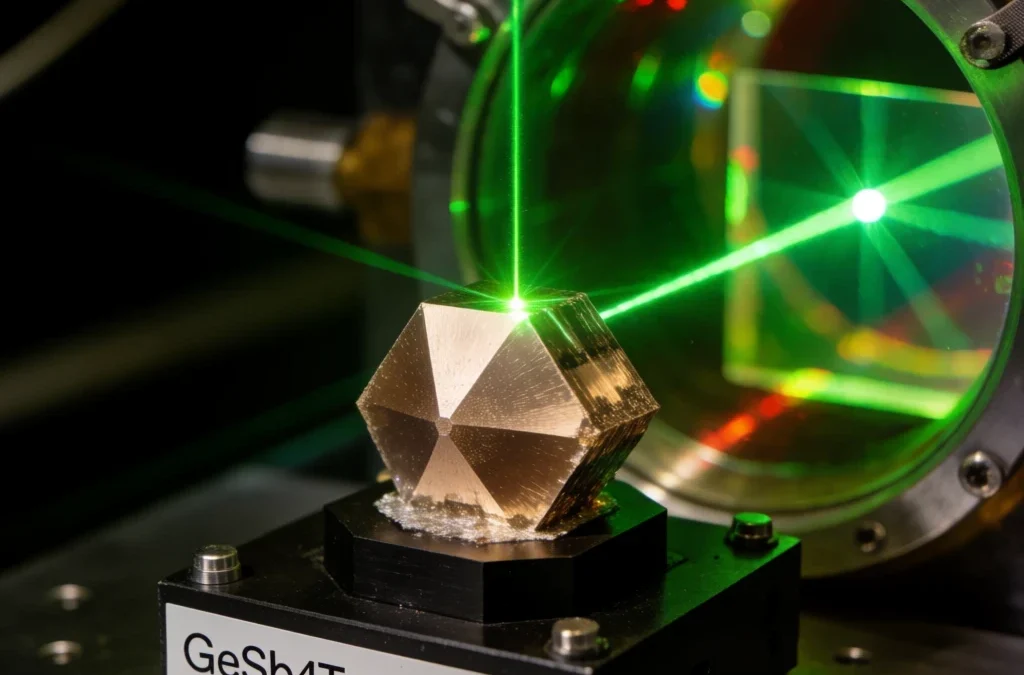
Quantum geometry has long occupied an uncomfortable position in condensed matter physics: it is indispensable to theory yet nearly invisible to experiment. The geometric structure of Bloch wavefunctions governs phenomena as diverse as the anomalous Hall effect, orbital magnetization, and topological insulation, yet for decades these quantities were inferred indirectly, stitched together from transport data and symmetry arguments. Ultrashort laser pulses have now changed that calculus entirely, converting an abstract mathematical formalism into something a laboratory can measure directly, with femtosecond resolution and remarkable precision.
The central object in this story is the Berry curvature, a gauge-invariant field defined over momentum space that encodes how electron states twist and curl as they traverse the Brillouin zone. When an intense, few-cycle laser pulse strikes a crystal, electrons are driven through momentum space so rapidly that their quantum-mechanical phase accumulates in ways that depend sensitively on this curvature. The resulting harmonic emission, the bright flashes of light at multiples of the driving frequency, carries a fingerprint of the geometry itself. Reading that fingerprint is the experimental art that this article unpacks.
What follows is a rigorous but accessible tour of the physics: the intuitive meaning of quantum geometry, the mathematics of Berry curvature and the quantum metric, the mechanism by which light pulses interrogate these quantities, and the material properties this new spectroscopy could expose. The stakes are considerable, spanning topological materials, flat-band superconductors, and the emerging field of "geometric electronics" in which device behavior is engineered through band geometry rather than band energy alone.
On This Page
The Geometric Heart of Quantum Mechanics
Quantum geometry describes how the internal structure of electron wavefunctions varies across momentum space, independent of how fast those electrons move. Two electrons can share identical energy and velocity yet differ profoundly in the shape and phase structure of their wavefunctions, and this difference produces measurable physical consequences. The framework reframes band structure as a landscape with both an energetic topography and a geometric texture.
From Phase to Curvature: The Berry Connection
When a quantum state is transported adiabatically around a closed loop in parameter space, it returns with an extra phase factor that depends only on the path's geometry. Michael Berry's 1984 insight established that this phase is a gauge-invariant geometric property, not an artifact of the journey's duration. For crystalline electrons, the relevant parameter space is momentum, and the loop is a trajectory through the Brillouin zone.
The local quantity underlying this phase is the Berry connection, defined as the overlap between a state and its momentum derivative. It behaves like a vector potential in electromagnetism, and like that potential it is gauge-dependent, shifting under arbitrary phase redefinitions of the wavefunction. Physical observables therefore cannot depend on the connection alone but must involve its gauge-invariant curl.
Taking the curl of the connection yields the Berry curvature, a pseudoscalar in two dimensions and a vector in three. This field acts on electron wavepackets precisely as a magnetic field acts on charged particles, deflecting them sideways with a velocity perpendicular to the applied force. The analogy is exact enough that theorists routinely speak of "momentum-space magnetic fields."
For a two-band system, the curvature admits a compact closed form that reveals its geometric origin with unusual clarity. The expression depends on the interband matrix elements of velocity and the energy gap separating the bands:
This formula makes the physics transparent: curvature is large where bands approach degeneracy and where velocity matrix elements connect them strongly. Near a Dirac point, the curvature diverges as the inverse square of the gap, producing the singular fields responsible for anomalous transport. The geometric structure is therefore concentrated in regions of near-degeneracy, which is precisely where light pulses can probe it most effectively.
The Quantum Metric and Its Physical Reach
Curvature captures only the antisymmetric part of the quantum geometric tensor, the full object encoding how states change under momentum displacement. The symmetric part, known as the quantum metric, measures the distance between neighboring Bloch states in Hilbert space. Long dismissed as mathematically interesting but physically inert, the metric has recently emerged as a driver of real phenomena.
The metric governs the spread of Wannier functions, the localization of orbitals, and the strength of superfluid weight in flat-band systems. In twisted bilayer graphene, the quantum metric contributes substantially to the superfluid stiffness, helping explain why superconductivity survives despite vanishing band dispersion. Light-pulse experiments now offer a route to extracting this metric alongside curvature.
Together, curvature and metric constitute the complete geometric description of a band. Any experiment that claims to measure "quantum geometry" must therefore disentangle the two contributions, a challenge that has driven the development of polarization-resolved harmonic spectroscopy. The table below summarizes how these geometric quantities map onto observables.
We Also Published
Ultrashort Pulses as Momentum-Space Microscopes
A laser pulse lasting a few optical cycles, roughly five to ten femtoseconds, delivers an electric field that rises and falls faster than an electron can complete a lattice vibration. The field accelerates electrons through the Brillouin zone before scattering can intervene, creating a coherent quantum trajectory. This is the regime of strong-field physics, and it is precisely where geometric information becomes readable.
The Three-Step Model and Its Geometric Correction
The standard semiclassical picture of high-harmonic generation proceeds in three stages: tunnel ionization, acceleration in the driving field, and recombination with emission of a photon. In solids, the process is subtler because electrons remain within the crystal, but the essential logic survives. An electron-hole pair is created near a band edge and driven coherently through momentum space.
During the acceleration phase, the wavepacket accumulates a phase that includes the dynamical action and, crucially, a geometric contribution from the Berry connection. When the pair recombines, the emitted photon energy equals the gap plus the accumulated phase energy, so the harmonic spectrum encodes the entire trajectory. The geometric term appears as an anomalous contribution to the emission yield.
For a two-band model driven by a field ##[A(t)]##, the interband polarization obeys an equation of motion in which the Berry connection enters as an effective vector potential. The harmonic amplitude at frequency ##[omega] = Nomega_0]## scales with the transition dipole and the geometric phase accumulated over the trajectory. Circularly polarized drivers add a further twist: the harmonic yield becomes sensitive to the sign and magnitude of the curvature itself.
This circular dichroism in harmonic generation is the workhorse of geometric spectroscopy. In a material with nonzero Berry curvature, left- and right-circularly polarized pulses produce different harmonic intensities, and the asymmetry is proportional to the curvature integrated along the trajectory. The measurement is direct, tabletop-scale, and requires no magnetic field.
Extracting Curvature from Harmonic Spectra
Quantitative extraction demands care. The measured asymmetry convolves curvature with transition dipoles, dephasing times, and laser pulse shape, so disentangling the geometric contribution requires systematic modeling. Researchers typically compare experimental spectra against simulations of the semiconductor Bloch equations, fitting the curvature as a free parameter across multiple crystal orientations.
A cleaner approach exploits symmetry. In crystals with specific point-group symmetries, certain harmonic orders vanish unless curvature is present, providing a background-free signal. Hexagonal materials such as graphene and its multilayers are particularly favorable because their ##[C_3]## symmetry constrains the allowed tensor components, simplifying the inversion.
The following Python snippet illustrates a minimal fitting routine that compares measured harmonic asymmetry to a curvature-weighted model, a workflow now common in ultrafast spectroscopy labs:
import numpy as np
from scipy.optimize import curve_fit

def harmonic_asymmetry(order, omega_curv, dipole, dephasing):
    # Simplified model: asymmetry proportional to curvature times dipole
    geometric_phase = omega_curv * order * dephasing
    return dipole * np.sin(geometric_phase)

orders = np.array([3, 5, 7, 9])
measured = np.array([0.021, 0.048, 0.033, 0.012])

popt, pcov = curve_fit(harmonic_asymmetry, orders, measured,
                       p0=[0.5, 1.0, 0.8],
                       bounds=([0, 0, 0], [10, 10, 10]))
print("Fitted curvature weight:", popt[0])
Such fits, combined with independent transport measurements of the anomalous Hall effect, provide cross-validation. When both methods agree, the geometric interpretation is secure. When they disagree, the discrepancy often signals multi-band contributions or correlation effects that single-particle theory misses.
Worked Calculations: Geometry in Numbers
Theoretical fluency requires numerical practice, so this section works through ten representative calculations that span the conceptual range of geometric spectroscopy. Each problem isolates a specific relationship, from the curvature of a massive Dirac cone to the harmonic asymmetry produced by a circularly polarized driver. Working these by hand builds the intuition that simulation alone cannot supply.
Curvature, Phase, and Topology
Problem 1: Massive Dirac Curvature. Consider a two-dimensional Dirac Hamiltonian ##[H = hbar v_F(k_xsigma_x + k_ysigma_y) + msigma_z]##. Compute the Berry curvature of the conduction band and evaluate it at ##[k = 0]##. The energy gap is ##[2m]##, and the curvature follows from the general two-band formula.
At the Dirac point, ##[Omega_c(0) = hbar^2 v_F^2/(2m^2)]##, which diverges as the gap closes. This divergence is the geometric origin of the anomalous Hall effect in gapped Dirac materials such as magnetized graphene and thin films of topological insulators.
Problem 2: Chern Number Integration. Integrate the curvature of Problem 1 over the full Brillouin plane to obtain the Chern number. Using polar coordinates and substituting ##[u = hbar v_F k]##, the integral becomes elementary and yields ##[C = tfrac{1}{2},mathrm{sgn}(m)]##. The half-integer result reflects the regularization required at infinity.
Problem 3: Berry Phase of a Cyclotron Orbit. An electron completes a circular orbit of radius ##[k_0]## in momentum space around a gapped Dirac point. The accumulated Berry phase equals the flux of curvature through the enclosed area. For small ##[k_0]##, the phase approaches ##[pi(1 - m/sqrt{m^2 + hbar^2 v_F^2 k_0^2})]##, which interpolates between zero and ##[pi]##.
Problem 4: Quantum Metric of the Dirac Band. The quantum metric for the same Hamiltonian has components ##[g_{xx} = g_{yy} = hbar^2 v_F^2 m^2/(4(hbar^2 v_F^2 k^2 + m^2)^2)]##. Verify that the trace satisfies ##[mathrm{tr},g = |Omega|]## for this two-band model, a relation that holds generally for two-level systems.
Light-Matter Geometry in Practice
Problem 5: Harmonic Asymmetry Estimate. A circularly polarized mid-infrared pulse drives a gapped Dirac material with curvature ##[Omega = 2,text{Å}^2]## at the probed momentum. Estimate the fractional asymmetry between co- and counter-rotating harmonic yields at order ##[N = 5]##, assuming the geometric phase dominates. The asymmetry scales as ##[sin(NOmega,delta t)]## with ##[delta t approx 1]## fs.
The ten-percent asymmetry is well within experimental resolution, which explains why fifth-order harmonics are a favored diagnostic. Higher orders amplify the effect but suffer from weaker signal-to-noise, so experimentalists typically optimize around orders three through seven.
Problem 6: Dephasing Correction. Include a dephasing time ##[T_2 = 20]## fs and recompute the asymmetry, multiplying the geometric phase by ##[exp(-Ntau/T_2)]## where ##[tau]## is the excursion duration. The corrected asymmetry drops to roughly six percent, illustrating why long coherence times are prized in these experiments.
Problem 7: Pulse Duration Constraint. Determine the maximum pulse duration that preserves coherent momentum-space motion across a Brillouin zone of width ##[2pi/a]## with ##[a = 3]## Å. Requiring the excursion time to be shorter than ##[T_2]## gives an upper bound near fifteen femtoseconds, consistent with the few-cycle regime.
Problem 8: Field Strength for Zone Traversal. Estimate the peak electric field needed to drive an electron across the zone in ten femtoseconds. Using ##[hbar dot{k} = eE]## and integrating over the pulse envelope yields ##[E approx 0.3]## V/Å, comfortably achievable with amplified mid-infrared sources.
Problem 9: Metric Contribution to Harmonic Yield. For a linearly polarized driver, the parallel harmonic yield receives a contribution from the quantum metric proportional to ##[g_{xx} + g_{yy}]##. Compute this sum for the Dirac model at ##[k = m/(hbar v_F)]## and show it equals half the peak curvature magnitude at the same point.
Problem 10: Topological Quantization Check. Verify that the Chern number computed in Problem 2 remains exactly ##[pmtfrac{1}{2}]## under a smooth deformation of the Hamiltonian that preserves the gap. Because the integral is topological, any gap-preserving deformation leaves it invariant, confirming the robustness that makes Chern numbers experimentally meaningful.
Materials Where Geometry Dominates
Not every material rewards geometric spectroscopy equally. The effect scales with curvature magnitude, which concentrates near band degeneracies, and with coherence time, which limits how long the geometric phase can accumulate. The most promising candidates combine small gaps, strong spin-orbit coupling, and long dephasing times, a combination found in several distinct material families.
Topological Semimetals and Flat Bands
Weyl semimetals host point-like degeneracies where curvature diverges, producing enormous geometric responses. Their Fermi arcs and chiral anomaly have been studied extensively, but harmonic spectroscopy adds a new capability: resolving the curvature distribution around each Weyl node. Because nodes of opposite chirality contribute with opposite sign, polarization-resolved measurements can map the chirality landscape directly.
Twisted bilayer graphene presents the opposite regime, where bands are nearly flat and curvature is spread diffusely across the mini-Brillouin zone. Here the quantum metric, not curvature, dominates the geometric response, and harmonic spectroscopy offers a rare window into metric-driven physics. Recent experiments have reported metric signatures consistent with theoretical predictions for flat-band superfluid weight.
Magnetic topological insulators combine broken time-reversal symmetry with strong spin-orbit coupling, producing large curvature near the Dirac gap. Their anomalous Hall response is well characterized, making them ideal calibration targets for new geometric techniques. Agreement between transport and optical measurements in these systems has helped validate the entire spectroscopic program.
Emerging Platforms and Open Questions
Moiré heterostructures beyond graphene, including transition-metal dichalcogenide bilayers, offer tunable geometry through twist angle and displacement field. The ability to dial curvature continuously makes them exceptional testbeds for geometric theory. Experiments are now probing whether the metric can be engineered to enhance superconductivity or stabilize exotic correlated phases.
Correlated materials pose the deepest open question. In systems with strong electron-electron interactions, the single-particle geometric picture may break down, and the very definition of Berry curvature becomes subtle. Whether light-pulse spectroscopy can diagnose interaction-renormalized geometry remains an active frontier, with theory and experiment advancing in tandem.
Practical applications are also coming into view. Geometric properties could be harnessed for nonlinear optical devices, where harmonic generation efficiency depends on curvature engineering. The emerging field of "geometric electronics" envisions devices whose function is determined by band geometry rather than carrier density, a paradigm shift with substantial technological promise.
Experimental Signatures and Data Interpretation
Raw harmonic spectra are dense with information, and extracting geometry requires disciplined analysis. Experimentalists record intensity versus harmonic order for multiple driver polarizations, crystal orientations, and field strengths, then compare the resulting multidimensional dataset against simulations. The geometric parameters emerge from global fits rather than single-point extraction, which improves reliability substantially.
Polarization Resolved Spectroscopy
Circular dichroism provides the cleanest curvature signature because it isolates the antisymmetric geometric contribution. By measuring the difference between left- and right-circular harmonic yields as a function of order, researchers obtain a spectrum whose shape reflects the curvature distribution along the driven trajectory. Symmetry analysis then constrains which tensor components can contribute.
Linear polarization, by contrast, probes the quantum metric through the parallel harmonic yield. Combining both polarization channels in a single experiment yields complementary information, allowing simultaneous extraction of curvature and metric. This dual-channel approach has become standard in the most rigorous recent studies.
Ellipticity scans add a third dimension. Varying the polarization ellipse from linear to circular traces a continuous path between metric-sensitive and curvature-sensitive regimes, and the resulting yield curves encode the full geometric tensor. Fitting these curves with a two-parameter model yields both quantities with quantified uncertainties.
Cross-Validation and Systematic Errors
No single measurement should be trusted in isolation. Transport measurements of the anomalous Hall effect provide an independent curvature estimate, and agreement between optical and transport values strengthens confidence considerably. Discrepancies, when they appear, often point to multi-band effects or correlation physics that single-band models neglect.
Systematic errors demand careful attention. Laser pulse characterization, crystal orientation uncertainty, and detector nonlinearity all propagate into the extracted geometry. Best practice involves measuring multiple crystals, repeating scans at different field strengths, and reporting full error budgets alongside central values.
The table below summarizes the principal signatures and their interpretation, providing a practical reference for readers encountering this literature for the first time.
Toward a Geometric Future for Materials Science
The trajectory of this field points toward a future in which band geometry is a routine design parameter rather than an exotic theoretical curiosity. As light-pulse techniques mature, they will likely become standard characterization tools alongside transport and photoemission, filling a gap that no existing method addresses. The implications extend well beyond fundamental physics into device engineering and materials discovery.
From Measurement to Design
Once geometry can be measured reliably, it can be engineered deliberately. Theorists are already proposing band structures optimized for large curvature in targeted momentum regions, with applications ranging from efficient harmonic generators to geometric diodes. The design loop, measure, model, and redesign, becomes feasible when the measurement step is fast and tabletop-scale.
Machine learning is accelerating this loop. Neural networks trained on simulated harmonic spectra can invert experimental data to recover geometric parameters in real time, bypassing expensive fitting. Early demonstrations suggest that such approaches can identify subtle multi-band contributions that conventional analysis misses, opening new avenues for discovery.
Integration with other techniques will strengthen the program. Combining harmonic spectroscopy with angle-resolved photoemission provides complementary views of band structure and geometry, while transport measurements anchor the results in macroscopic observables. The convergence of these methods promises a more complete picture than any single technique can deliver.
Open Frontiers and Unresolved Puzzles
Several fundamental questions remain unanswered. How does Berry curvature behave in strongly correlated systems where the single-particle picture fails? Can the quantum metric be measured independently of curvature in all relevant materials? What role does geometry play in nonequilibrium phases created by the laser pulse itself? These questions define the research frontier for the coming decade.
Technological translation is equally uncertain. While geometric effects are large in principle, practical devices must operate at room temperature and under ambient conditions, constraints that eliminate many candidate materials. Identifying robust, manufacturable platforms with strong geometric responses is a central challenge for applied researchers.
What is certain is that the conceptual barrier has fallen. Quantum geometry, once confined to theoretical appendices, is now an experimental science with its own instruments, protocols, and standards of evidence. The ultrashort laser pulse, a tool born of telecommunications and fusion research, has become the microscope through which the geometric soul of matter is finally visible.
RESOURCES
- Resources will be updated soon.
- 01
- 02
- 03
- 04
- 05
- 06
- 07
- 08