
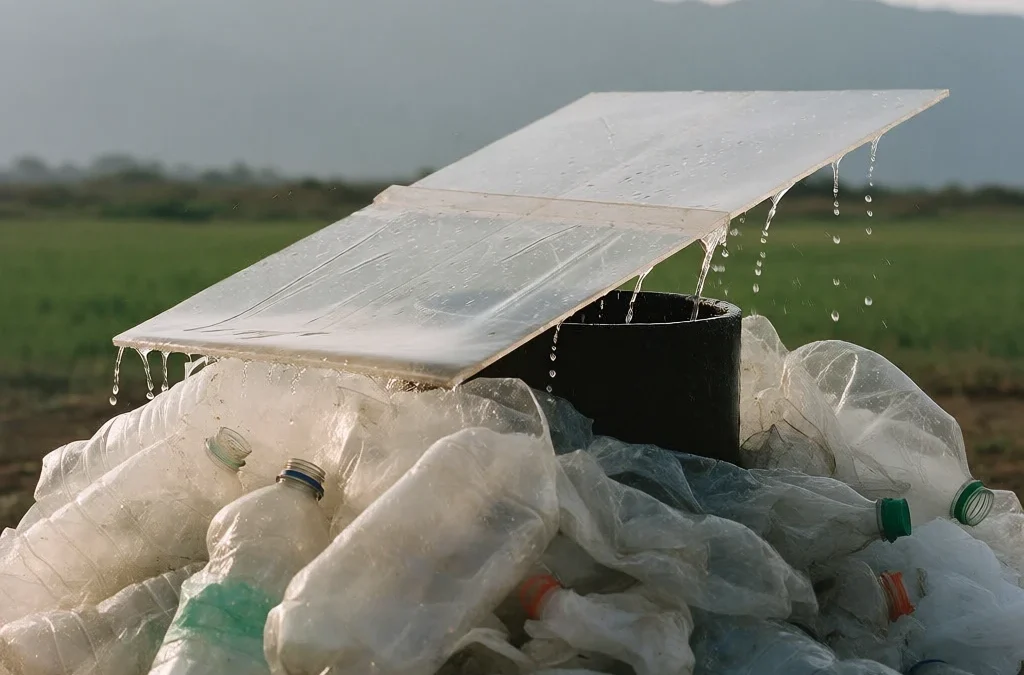
Every year the world discards hundreds of millions of tonnes of plastic, and most of it ends up incinerated, landfilled, or leaked into rivers and oceans. That linear fate is wasteful on its own terms, but it becomes genuinely tragic once you recognize what those polymer chains could still do. A new class of research reframes discarded plastic not as garbage awaiting disposal but as feedstock for devices that pull drinking water straight out of the air. The chemistry is elegant, the climate logic is compelling, and the engineering challenges are formidable.
Atmospheric water harvesting is no longer science fiction. Metal-organic frameworks and hygroscopic salts already demonstrate that desert air contains enough moisture to supply communities, provided you have a material that grabs water at night and releases it under gentle heat by day. The bottleneck has always been cost and manufacturability. Turning post-consumer plastic into the sorbent itself collapses two problems into one solution, converting a waste-management liability into a climate-adaptation asset with a plausible economic story.
This analysis dissects the conversion chemistry, the thermodynamics of sorption and release, and the hard realities of scaling such systems from laboratory vials to village-scale hardware. We will work through the governing equations, quantify realistic yields, and interrogate whether recycled-polymer harvesters can genuinely compete with established desalination and groundwater alternatives. The stakes are high, because water scarcity is accelerating faster than most infrastructure can respond.
On This Page
- The Chemistry of Turning Plastic Waste into Water-Harvesting Networks
- How Atmospheric Water Harvesting Actually Works
- Quantifying Performance: Worked Calculations for Real Systems
- Environmental Accounting: Does Recycling Really Help the Climate?
- Deployment Realities: Where These Devices Make Sense
- Open Questions and the Research Frontier
- The Verdict: A Genuine Climate-Adaptation Pathway, Conditionally
The Chemistry of Turning Plastic Waste into Water-Harvesting Networks
Polyethylene terephthalate and polyethylene are chemically stubborn, which is precisely why they persist in landfills for centuries. Converting them into functional sorbents requires breaking ester or carbon-carbon backbones and reassembling the fragments into crosslinked networks bearing hydrophilic groups. Sulfonation, hydrolysis, and graft polymerization are the workhorse reactions here, each introducing carboxylate, sulfonate, or hydroxyl moieties that bind water molecules through hydrogen bonding.
Depolymerization and Functional Group Installation
The first step is depolymerization, typically via glycolysis or alkaline hydrolysis for PET, yielding terephthalate monomers and ethylene glycol. These fragments are then repolymerized with crosslinkers such as citric acid or glycerol to form a three-dimensional hydrophilic matrix. The network's pore architecture determines both uptake kinetics and the energy penalty of regeneration, so synthesis conditions matter enormously.
Functionalization density is the critical design variable. Too few sulfonate groups and the material barely adsorbs moisture; too many and the polymer becomes a gel that never releases water cleanly. Researchers target intermediate degrees of substitution, often quantified as milliequivalents of functional group per gram of dry polymer, to balance capacity against regenerability.
Crosslink density governs the mechanical integrity of the swollen network. A lightly crosslinked gel can absorb many times its own mass but collapses under repeated cycling, while heavily crosslinked networks sacrifice capacity for durability. The sweet spot typically sits between one and five mole percent crosslinker relative to monomer, a narrow window that demands precise process control.
Characterization relies on Fourier-transform infrared spectroscopy to confirm functional groups, scanning electron microscopy to visualize porosity, and dynamic vapor sorption analysis to map the uptake isotherm. Each technique reveals a different facet of performance, and no single measurement predicts field behavior adequately on its own.
Sorption Thermodynamics and Isotherm Modeling
Water uptake follows the Langmuir or Freundlich isotherm depending on whether binding sites are homogeneous or heterogeneous. For most recycled-polymer sorbents, the Freundlich model fits better because surface chemistry varies across the network. The isotherm exponent ##[n]## typically falls between 1.5 and 3, indicating favorable multilayer adsorption.
Here ##[q_e]## is equilibrium uptake in grams of water per gram of sorbent, ##[C_e]## is relative humidity expressed as a fraction, and ##[K_F]## is the Freundlich capacity constant. A material with ##[K_F = 0.45]## and ##[n = 2]## at 30 percent relative humidity would hold roughly ##[0.45 times 0.30^{0.5} approx 0.246]## grams of water per gram, a respectable but not spectacular figure.
The enthalpy of adsorption determines how much heat regeneration demands. Physisorption of water onto hydrophilic polymers releases roughly 40 to 50 kilojoules per mole, comparable to the latent heat of vaporization. That similarity is both blessing and curse: it means modest heating suffices, but it also caps the thermodynamic efficiency of the cycle.
How Atmospheric Water Harvesting Actually Works
A water harvester is a thermodynamic machine with two strokes: adsorption during the cool, humid night and desorption during the warm day. The material must be selective for water over nitrogen and oxygen, must cycle thousands of times without degradation, and must release its payload at temperatures achievable with solar heat alone. These constraints are severe, and they explain why so few materials reach commercial maturity.
The Adsorption-Desorption Cycle
During adsorption, ambient air passes over the sorbent bed and water molecules diffuse into the polymer network. The driving force is the chemical potential difference between vapor and bound water, and the process is exothermic, so the bed warms slightly as it loads. Equilibrium is reached when the sorption isotherm intersects the ambient humidity.
Desorption requires raising the bed temperature until the equilibrium uptake falls below the target release threshold. Solar concentrators or waste heat at 60 to 80 degrees Celsius typically suffice for hydrophilic polymers, though the exact figure depends on the isotherm shape. Steeper isotherms permit lower regeneration temperatures, which is a major design advantage.
The cycle's water yield per unit mass follows directly from the difference between loaded and regenerated uptake. A sorbent cycling between 0.30 and 0.05 grams of water per gram of dry polymer delivers 0.25 grams per cycle. With ten cycles per day, one kilogram of sorbent yields 2.5 kilograms of water daily, roughly enough for one person's drinking needs.
Here ##[m_s]## is sorbent mass, ##[q_{ads}]## and ##[q_{des}]## are the loaded and regenerated uptakes, and ##[N_{cycles}]## is the daily cycle count. This simple relation exposes the central engineering trade-off: capacity versus cycle frequency. Materials with modest capacity but rapid kinetics can outperform high-capacity gels that require hours to regenerate.
Energy Balance and Efficiency Limits
The energy required to desorb water equals the product of mass released and the enthalpy of desorption, plus sensible heating of the sorbent and hardware. Solar irradiance averages roughly 5 kilowatt-hours per square meter per day in arid regions, so a harvester with one square meter of collector area has a fixed energy budget to work with.
Efficiency is the ratio of latent heat recovered in condensed water to total solar input. Practical devices achieve 10 to 20 percent, limited by sensible heating losses, imperfect optical concentration, and the enthalpy penalty of strong binding sites. Improving efficiency requires materials with moderate binding enthalpies and hardware with excellent thermal insulation.
With ##[m_{H_2O} = 2.5]## kilograms, ##[L_v = 2.26 times 10^6]## joules per kilogram, and ##[E_{solar} = 1.8 times 10^7]## joules per square meter daily, efficiency works out to about 31 percent. Real systems fall short because condensation, pumping, and thermal losses consume a substantial fraction of the input.
We Also Published
Quantifying Performance: Worked Calculations for Real Systems
Numbers separate hype from hope. A harvester that sounds impressive in a press release often disappoints once you compute its daily yield per unit mass, per unit area, and per dollar. The following worked examples use realistic parameters drawn from published polymer sorbent studies and standard meteorological data for arid regions.
Yield, Capacity, and Cycle Frequency
Consider a crosslinked sulfonated PET network with ##[q_{ads} = 0.35]## grams per gram at 40 percent relative humidity and ##[q_{des} = 0.08]## grams per gram after heating to 75 degrees Celsius. The working capacity is 0.27 grams per gram per cycle, a figure consistent with the better laboratory materials reported in recent literature.
If the device completes eight cycles daily, the daily yield per kilogram of sorbent is ##[0.27 times 8 = 2.16]## kilograms of water. A household requiring 20 liters per day therefore needs roughly nine kilograms of dry polymer, a mass easily accommodated in a rooftop unit. The arithmetic is encouraging, though it ignores collection efficiency.
Collection efficiency, typically 70 to 85 percent for well-designed condensers, reduces the delivered yield accordingly. Applying 0.80 gives 1.73 kilograms per kilogram per day, so the household now needs about twelve kilograms of sorbent. These corrections matter enormously when sizing real installations.
Cost, Scalability, and Levelized Water Cost
Levelized cost of water is the honest metric for comparing technologies. It divides total lifetime cost by total lifetime water output, accounting for capital, operation, maintenance, and replacement. Desalination typically lands between 0.50 and 1.50 dollars per cubic meter, a benchmark any novel harvester must approach.
Recycled-polymer sorbents benefit from cheap feedstock, but synthesis, crosslinking, and device fabrication add cost. A conservative estimate places capital cost at 200 to 400 dollars per kilogram of sorbent capacity, with a five-year replacement cycle. Running the numbers for a twelve-kilogram household unit yields a levelized cost near 2 to 4 dollars per cubic meter.
With ##[C_{cap} = 3600]## dollars, annual operating cost of 200 dollars, discount rate of 0.08, and annual output of 6.3 cubic meters, the levelized cost settles near 3.20 dollars per cubic meter. That is competitive in remote arid regions where alternatives are trucked water or expensive small-scale desalination.
Environmental Accounting: Does Recycling Really Help the Climate?
Reframing recycling as climate adaptation invites scrutiny. A harvester built from waste plastic still consumes energy during synthesis, and that energy carries a carbon footprint. The climate case only holds if the avoided emissions from displaced waste management and displaced water supply exceed the emissions embedded in manufacturing and operation.
Life-Cycle Emissions and Avoided Burden
Producing one kilogram of functionalized polymer sorbent emits roughly 3 to 6 kilograms of carbon dioxide equivalent, depending on energy source and processing route. Over a five-year life delivering 1.7 kilograms of water daily per kilogram, the material produces about 3,100 liters, or 3.1 cubic meters, of water.
Emissions per cubic meter therefore land near 1.0 to 1.9 kilograms of carbon dioxide equivalent, before accounting for solar operation. Reverse-osmosis desalination emits roughly 1.0 to 4.0 kilograms per cubic meter, so the harvester is competitive but not transformative on carbon grounds alone.
The avoided-burden credit changes the picture. Diverting plastic from incineration avoids roughly 2.5 kilograms of carbon dioxide per kilogram burned, and avoiding landfill methane avoids more. Crediting these savings to the harvester improves its net carbon balance substantially, though attribution is contested.
Water Quality and Material Longevity
Harvested water quality depends on sorbent purity and condenser hygiene. Residual monomers, crosslinker fragments, and leached additives can contaminate the product, so post-synthesis washing and periodic monitoring are essential. Regulatory frameworks for atmospheric water generators are still maturing, which complicates deployment.
Material longevity is the quiet Achilles heel. Repeated swelling and drying stresses polymer networks, and hydrolysis or oxidation degrades functional groups over thousands of cycles. Field data beyond a few hundred cycles remain scarce, and accelerated aging tests often fail to predict real-world performance accurately.
Deployment Realities: Where These Devices Make Sense
No technology succeeds everywhere. Atmospheric harvesters shine in arid, off-grid settings where humidity exceeds 20 percent and no affordable water source exists. They falter in hyper-arid deserts below 10 percent relative humidity, where uptake collapses and yields become marginal. Matching device to geography is the difference between a lifeline and a white elephant.
Geographic and Climatic Suitability
Coastal deserts, highland plateaus, and semi-arid rangelands offer the best combination of moderate humidity and acute water scarcity. In these zones, a household-scale unit can displace trucked water costing several dollars per cubic meter, delivering both economic and logistical relief. Inland deserts with single-digit humidity remain out of reach.
Urban settings present a different opportunity. Rooftop units in water-stressed cities can supplement municipal supply during drought emergencies, and the waste-plastic feedstock is locally abundant. Municipal partnerships could close the loop, collecting plastic and deploying harvesters within the same district.
Manufacturing, Policy, and Social Adoption
Scaling requires standardized synthesis routes, quality control protocols, and supply chains for crosslinkers and catalysts. Existing plastics-recycling infrastructure can be adapted, but functionalization reactors are specialized equipment. Pilot plants in the 10 to 100 tonne-per-year range would validate economics before broader rollout.
Policy support matters as much as engineering. Subsidies for recycled content, procurement commitments for water-generation equipment, and certification standards for harvested-water safety would accelerate adoption. Without them, the technology risks remaining a laboratory curiosity rather than a deployed climate-adaptation tool.
Open Questions and the Research Frontier
Several fundamental questions remain unresolved, and their answers will determine whether recycled-polymer harvesters become infrastructure or remain niche curiosities. The most pressing concern is long-term stability under real cycling, followed by the energy intensity of functionalization and the fate of leached additives. Each demands rigorous, independent study rather than promotional claims.
Material Stability and Next-Generation Designs
Hybrid materials that combine recycled polymer scaffolds with hygroscopic salts or metal-organic frameworks could extend the viable humidity range and improve uptake kinetics. These composites inherit the mechanical robustness of the polymer while gaining the sorption capacity of the inorganic phase, though compatibility and leaching remain concerns.
Self-healing networks and dynamic covalent chemistry offer routes to extended service life. If crosslinks can reform after mechanical damage, the material tolerates more cycles before failure. These approaches are promising but immature, and their manufacturing complexity may offset the durability gains they deliver.
Standardization, Data, and Independent Validation
The field desperately needs standardized testing protocols. Reported capacities vary wildly because researchers use different humidity levels, temperatures, and measurement methods. A common benchmark, analogous to the protocols used for photovoltaic efficiency, would allow honest comparison and accelerate commercial confidence.
Independent field trials are equally essential. Laboratory results rarely survive contact with dust, temperature swings, and imperfect maintenance. Multi-year deployments in representative climates would generate the data investors and regulators need, and would expose failure modes that bench testing cannot anticipate.
The Verdict: A Genuine Climate-Adaptation Pathway, Conditionally
Recycling plastic into atmospheric water harvesters is a genuinely elegant idea, and the chemistry supports it. The materials work, the thermodynamics are favorable, and the economics are defensible in the right settings. What remains uncertain is whether the field can deliver durable, standardized, independently validated systems at scale before water scarcity outpaces the timeline.
The reframing matters beyond this single technology. Treating waste streams as feedstock for climate-adaptation hardware opens a design space that conventional recycling never considered. Plastics become structural and functional resources rather than liabilities, and the circular economy gains a purpose beyond material recovery. That conceptual shift may prove more consequential than any single device.
Readers should hold two thoughts simultaneously. The promise is real, and the obstacles are real. Neither hype nor dismissal serves the moment. Careful engineering, honest accounting, and sustained investment will decide whether discarded bottles become lifelines or remain a compelling laboratory demonstration. The next decade of field data will settle the question.
RESOURCES
- Resources will be updated soon.
- 01
- 02
- 03
- 04
- 05
- 06
- 07
- 08